The mountain's own cow
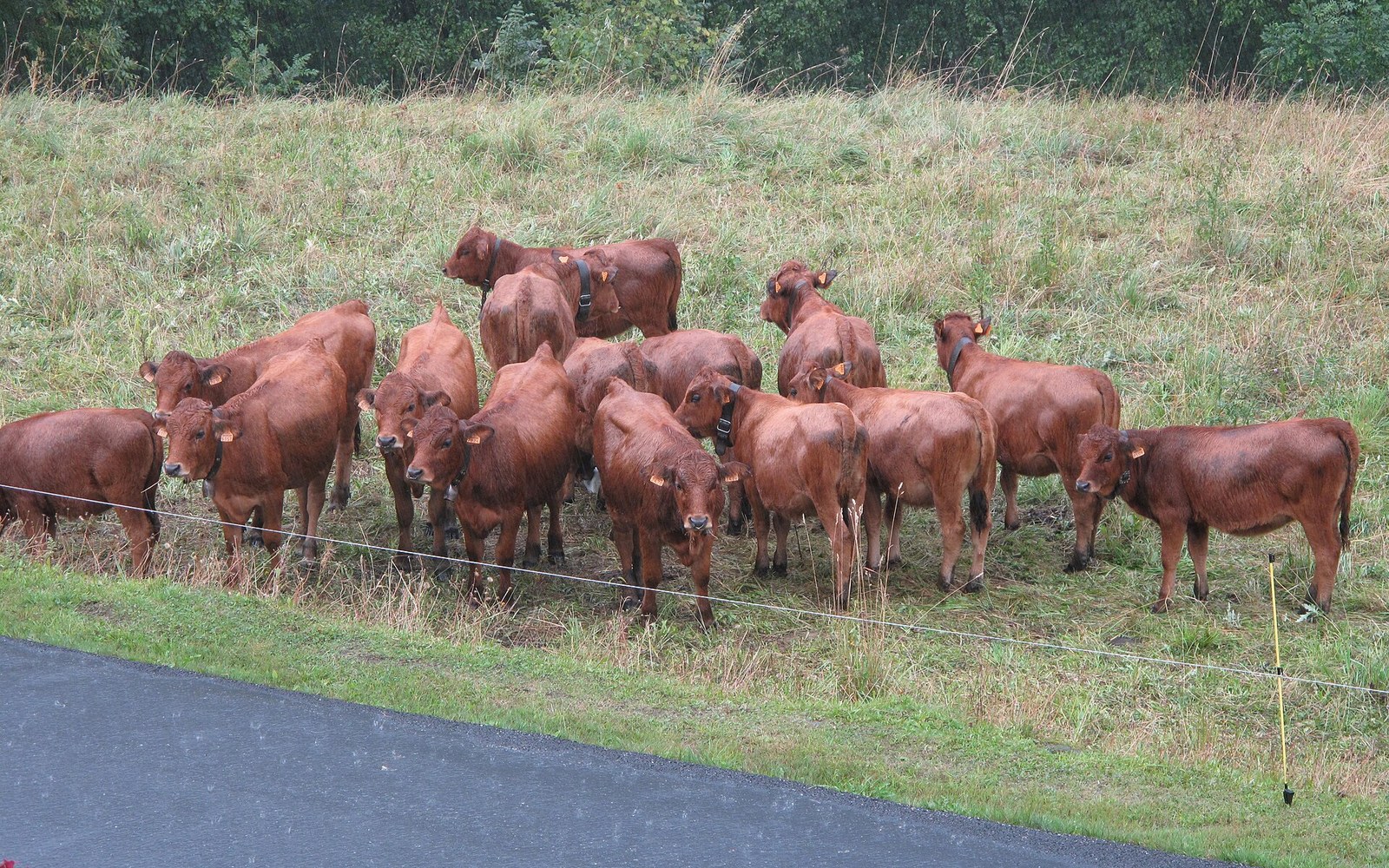
The Tarine — also called Tarentaise after the valley where the breed formed — is the colour of milky coffee from muzzle to tail, with a dark dorsal stripe, a black-tipped muzzle and a black switch at the end of the tail. She is not a large animal. That compactness is not an accident; it is the result of centuries of selection on steep, rocky ground where bulk is a liability and sure-footedness is everything.
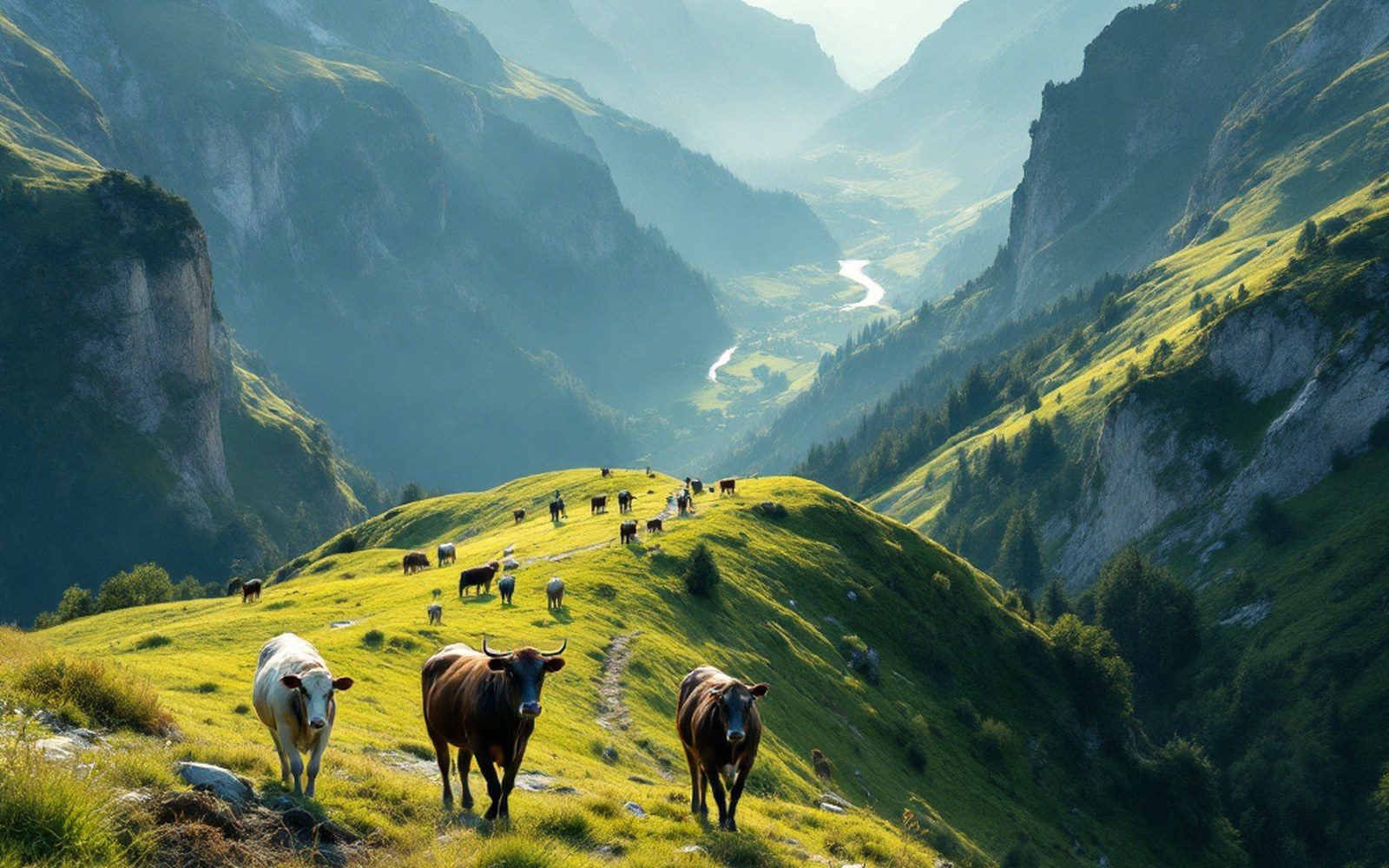
The breed takes its name from the Tarentaise valley, the long glacial corridor running south-east from Albertville toward Bourg-Saint-Maurice and the Col de l'Iseran in Savoie. By the nineteenth century the Tarine was already being documented as a distinct regional type, and formal herdbook registration ↗ dates to 1888. The valley is adjacent to the Bauges and the Aravis ranges — the massifs that frame the pays de Faverges — and the breed moved freely between them as summer grazing patterns demanded.
Key characteristics
- Coatuniform milky brown, dark dorsal stripe, black muzzle tip and tail switch
- Sizecompact; smaller than Montbéliarde, well-suited to steep terrain
- Milk yieldlower daily volume than Montbéliarde; higher butterfat
- Curd qualityfirm, consistent caillé; suited to cooperative cheesemaking
- Herdbookestablished 1888
Why the alpage suits her
What makes the Tarine valuable on high pasture is a combination of characteristics that don't always travel together. She forages aggressively on thin mountain grass, traverses long distances between grazing patches without losing condition, and drinks comparatively little water — useful when the only supply is a snowmelt stream. Her hooves are dense and well-cupped, gripping wet limestone and scree in a way that larger, heavier breeds simply cannot. On the steeper alpages above Seythenex and Chevaline, where the gradient can make a summer day's grazing genuinely arduous, that morphology is the difference between a productive animal and an injured one.
Her milk yield is modest by the standards of lowland dairying. She gives less per day than a Montbéliarde under the same conditions, and considerably less than a Holstein. But the butterfat content is high, and the protein structure suits cheesemaking: the milk forms a firm, clean caillé — the curd — that releases whey predictably and holds its shape well in the mould. Cheesemakers working with Tarine milk often describe it as "working well," meaning it behaves consistently across seasons, which matters enormously in cooperative production where one vat holds the pooled milk of several farms.
Designation status
The Tarine is one of three breeds admitted by the Reblochon de Savoie AOP specification — the others being Abondance and Montbéliarde. The AOP's cahier des charges, the rulebook managed by the Institut national de l'origine et de la qualité and published on the European Commission's eAmbrosia register ↗, specifies that milk must come only from these three breeds, with no crossbred animals permitted. The Tome des Bauges AOP operates an identical restriction on breed. This is not sentiment — it is a mechanism for tying the flavour of the cheese to a specific genetic and ecological context, which is the entire point of a protected designation.
Her hooves are dense and well-cupped, gripping wet limestone and scree in a way that larger, heavier breeds simply cannot.
Within a mixed herd, Tarines are sometimes kept alongside Abondances rather than Montbéliardes, because their grazing behaviour and size are compatible; they compete less aggressively at the pasture. On the alpages of the Massif des Bauges — the highland natural park that adjoins the Faverges communes — pure Tarine herds are still found on the most demanding terrain, precisely because no other admitted breed manages it as efficiently.
The breed has also attracted interest far outside the Alps. Canada, the United States and several African countries have imported Tarines for crossbreeding programmes aimed at improving hardiness in difficult climates, a fact tracked by the Food and Agriculture Organization's domestic animal diversity database ↗. In the Haute-Savoie, however, the Tarine is not an experiment or a heritage gesture — she is simply the cow that the mountain produced, and that the mountain still requires.