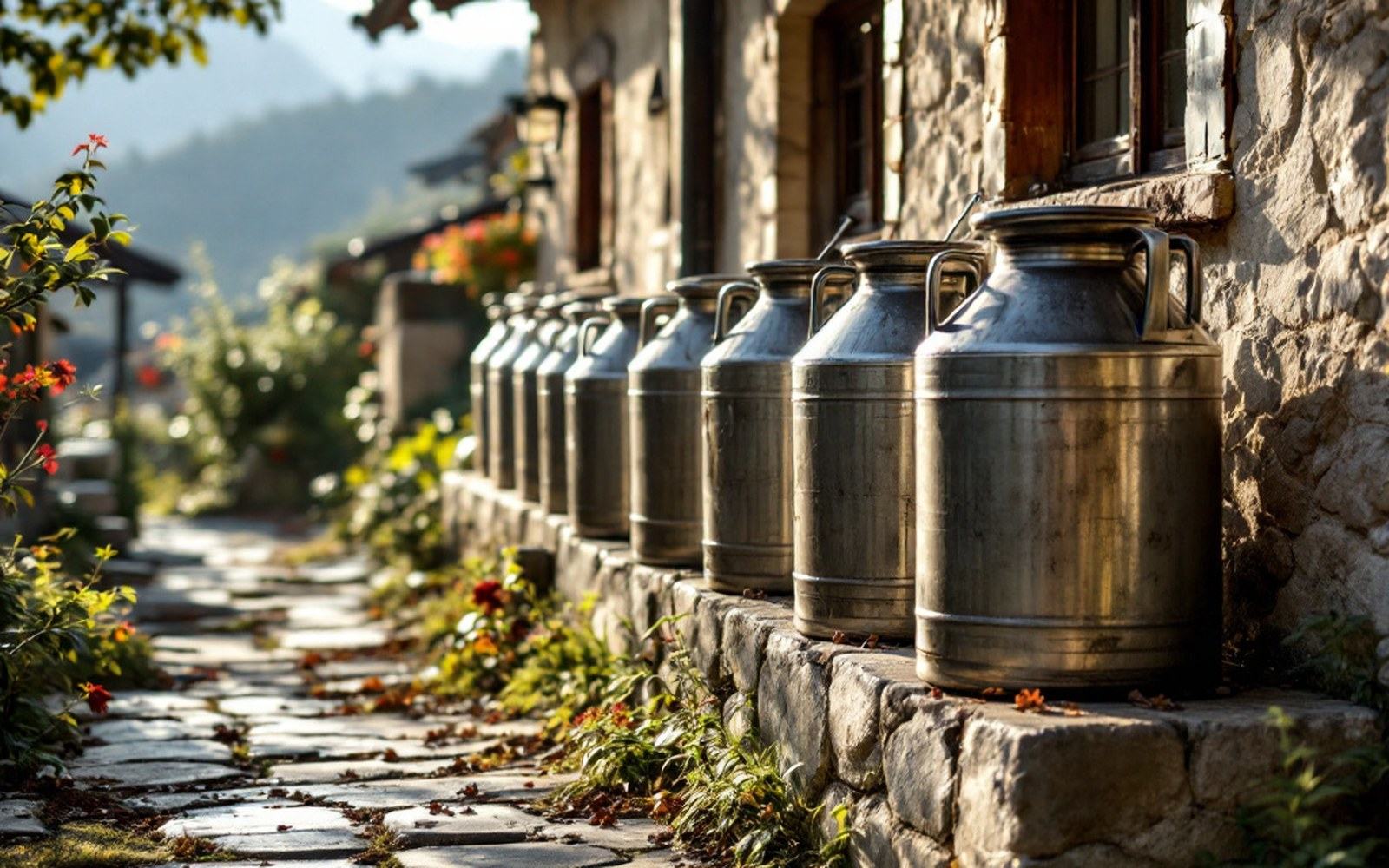
When one farm cannot fill a vat
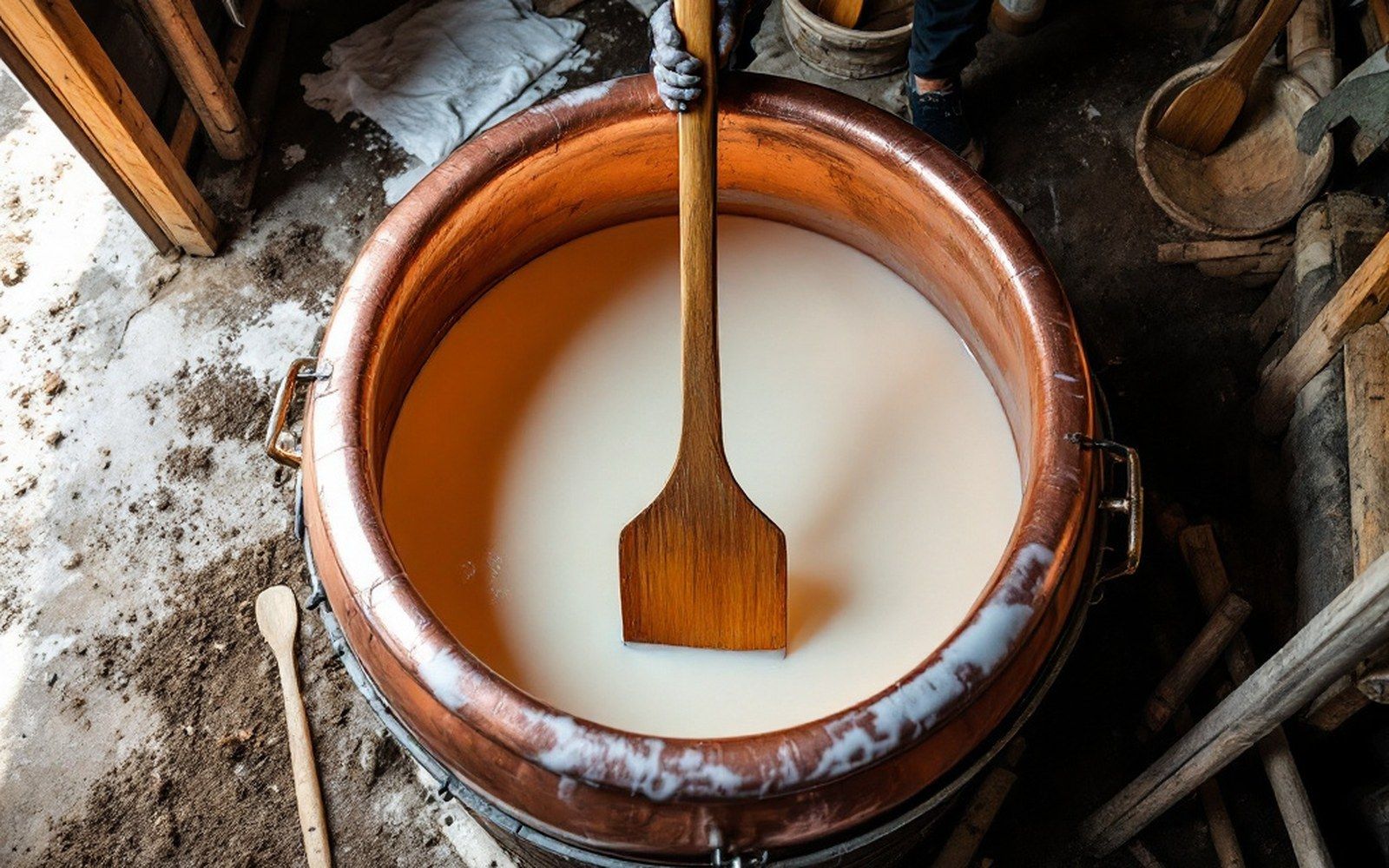
The copper vat at a mountain dairy holds a fixed volume, and a single family's herd has never reliably filled it. That basic arithmetic — too little milk, too large a vat — is the reason the fruitière exists at all. The word comes from the Old French for fruit in the sense of profit or yield: the neighbours pooled their milk, made cheese in common, and shared out the resulting wheels. The dairy was not a business in the ordinary sense; it was a shared infrastructure, closer in spirit to a mill or a common pasture than to a shop.
The logic was imposed by the mountain itself. In the valleys around Faverges and across the Massif des Bauges, herds were small and farms were dispersed. A single holding might run twenty or thirty cows through a summer on the alpage — the high summer pasture — but twenty cows produce perhaps four hundred litres a day at peak, and a wheel of Reblochon requires roughly eight to ten litres of milk per kilogram of finished cheese. The cooperative vat made sense because it guaranteed that each morning's milk would actually become something: a wheel of known size, datable, marketable, cellared under a shared roof.
The logic of pooling and what it demanded
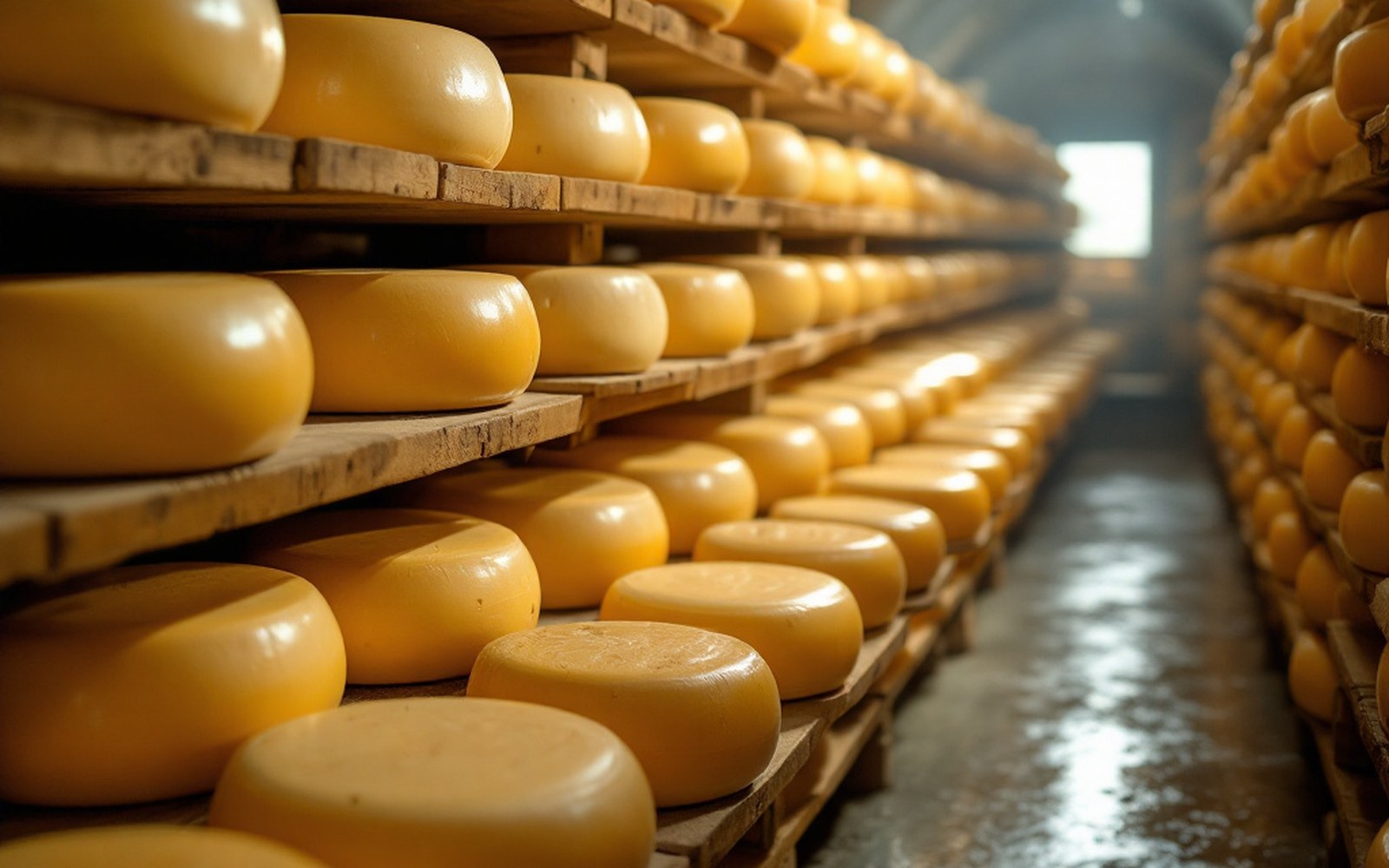
Bringing milk together from several farms is simple in principle and complicated in practice. Every participant contributes a different quantity each day, the quantities vary with the season, and the cheese produced at the end of the week cannot be divided like water. The solution the fruitières developed over centuries was the tour de rôle — members took finished wheels in turn, in rotation proportional to what they had brought to the vat. This required measurement. Every morning's delivery was recorded, often on a tally stick or in a ledger, and the running total determined whose turn it was. The system was not written into law; it was enforced by neighbourly accountability.
How the system worked — mechanically
- One farm's milk→ insufficient volume for a single wheel; cooperative pooling solved the arithmetic
- Daily delivery measuredand tallied per member; running total determined rotation of finished wheels (the tour de rôle)
- Consistency of milk quality →communal interest in hygiene and animal husbandry, enforced by social accountability before any legal specification existed
The institution that managed this was the fruitière itself, governed by its members and answerable only to them. In the communes around Faverges — Seythenex, Chevaline, and the villages along the approach to the Bauges — individual fruitières were sometimes tiny, a handful of families, sharing a single building with a dairy room, a cellar for affinage (the ripening of the cheese), and a hearth. The building might belong to the commune or to the members jointly. It was, in functional terms, a cooperative long before the cooperative had a legal definition.
What pooling also demanded was consistency. If your milk arrives warm, or acidifying because the cow was stressed, or tainted because the pail was not clean, you hurt everyone's cheese that day. The communal structure created a powerful shared interest in hygiene and animal husbandry that no individual producer operating alone would have had in the same form. This is not sentiment: the specification — the cahier des charges — that governs Reblochon de Savoie today still embeds requirements about milk quality, handling temperature, and the interval between milking and delivery that trace directly to the disciplines the fruitières enforced by custom long before any official body wrote them down.
From custom to designation
The formalization of the fruitière as a legal and commercial structure accelerated through the twentieth century, but the underlying model did not change. The Institut national de l'origine et de la qualité ↗ (INAO) administers France's protected designation system, and when Reblochon received its appellation d'origine contrôlée in 1958, the cahier des charges it produced codified what the fruitières had already been doing: milk from defined breeds — Abondance, Tarine, Montbéliarde — grazed on defined pastures, transformed within a defined area, and ripened for a minimum period. The European Commission's eAmbrosia register ↗ records the current protected designations across the EU; France's alpine cheeses occupy a significant portion of it.
The Syndicat Interprofessionnel du Reblochon, based at Thônes in the valley northeast of Faverges, coordinates the producers, the dairies and the affineurs under the designation today. Thônes is the historic capital of Reblochon country, and the valley between Thônes and the Annecy basin — with the Lac d'Annecy glinting at its western edge — has been the heartland of cooperative cheesemaking in this part of Haute-Savoie for as long as the records go back. The Parc naturel régional du Massif des Bauges, which covers much of the terrain immediately south of Faverges, adds a further layer of territorial identity that the designations explicitly tie their milk to.
The system was not written into law; it was enforced by neighbourly accountability.
Pooling milk also shaped what the cheese became. Reblochon is a small, relatively soft washed-rind wheel — small because the fruitières were small, and a small wheel ripens in a short cellar time, which suited a community where production and consumption were local and seasonal. Tome des Bauges, the grey-rinded wheel from the adjoining massif, follows a similar cooperative logic but with a thicker rind and a longer minimum affinage, reflecting slightly different altitudes and different seasonal rhythms on its pastures. Both cheeses are legible as products of their pooling systems, not just of their milk.

What the pool still means
Modern fruitières in the Faverges area are legal cooperatives under French law, with formal membership rules, audited accounts and contractual obligations to the designation bodies. The technology inside the dairy has changed — stainless steel tanks alongside or instead of copper, mechanized turning rigs in the cellar, electronic record-keeping — but the fundamental act has not: every morning, several farms' worth of milk arrives at a shared dairy and becomes a shared product. The emmorgeage — the washing and rubbing of the rind at intervals during affinage — is still performed by hand in the cellars of the smaller fruitières, a practice governed as much by accumulated knowledge as by written specification.
According to INAO, an AOP (Appellation d'Origine Protégée — protected designation of origin) requires that all stages of production take place within the defined geographic area. For a mountain cheese, that means the milk, the dairy and the cellar must all sit within the boundary. The pooled fruitière, gathering milk from farms within the same valley or massif, satisfies that requirement structurally in a way a single large industrial plant drawing from a wide catchment cannot. The designation and the cooperative reinforce each other; the architecture of sharing that the mountain imposed on these communities four or five centuries ago turns out to be exactly the architecture that a modern geographical indication needs.